
耐克森低碳计划
电缆数据透明推动低碳创新,助力更可持续的选择
耐克森低碳项目以持续创新为核心,基于环境数据透明化原则,旨在提升耐克森产品与服务的环境表现。该项目已在全球范围推广,覆盖所有完成生命周期评估(LCA)的耐克森产品。
作为这个独创项目的核心内容,耐克森率先为产品实现了二氧化碳数据环境标识,带有经认证生命周期评估的产品,其二氧化碳数据可直接从产品技术规格表中便捷获取。这是线缆行业内具有开拓性的举措。
截至2028年,耐克森全球低碳电缆中再生铜的使用占比将提升25%
70%耐克森在售电缆获得PEP环保护照认证
法国TWISTAL系列铝产品的碳排放减少40%
*Share of revenue from products sold with PEP declarations in Europe and North America in 2025.
**CO₂ savings achieved on the Nexans U1000 AR2V TWISTAL 4x1x240 rALU product range (Ecopassport® reference: NXNS-00040-V03.02-FR), compared to the same product reference without the improvements: recycled raw materials and aluminum produced using carbon-free energy.
Revealing what truly matters: low-carbon performance of cables
Although invisible to the naked eye, a cable's environmental footprint is yet real. It is present at every stage of its life cycle: from raw material sourcing to manufacturing, and from installation to end of life.
With its Low Carbon program, Nexans is committed to ensuring the transparency of its cables' environmental data by providing reliable information that allows the carbon footprint of a cable to be assessed at a glance. More than just information, it is a commitment to produce differently, with greater transparency and improved environmental performance.
It is the overall impact that a cable has on the environment throughout its life cycle. It is measured through life cycle assessments (LCA), certified by an external program and published in the form of Product Environmental Profile (PEP Ecopassport®) declarations.
Environmental data based on cable life cycle analysis
Designed to provide a quick and comprehensive overview, Nexans' environmental data display is based on a solidt set of indicators stemming from life cycle assessments (LCA), a standardized evaluation method that provides a multi-criteria, multi-stage environmental assessment of the entire cable life cycle.
Raw material sourcing
Obtaining the raw materials needed to manufacture the cable, including transportation.
Manufacturing
Transforming raw materials into finished products.
Logistics and distribution
Transport, storage, and distribution of the cable from the manufacturing site to the point of consumption.
Use
Period during which the product is consumed by the end user
End of life
Treatment applied to the cable when it is no longer in use (reuse, recycling, disposal, etc.).
At Nexans, each LCA is certified by an external body and published in the form of Product Environmental Profile (PEP Ecopassport®). This solid and rigid framework ensures a trustworthy and accurate basis on which our customers can rely to define their own low-carbon strategies.
How to read a cable's environmental data?
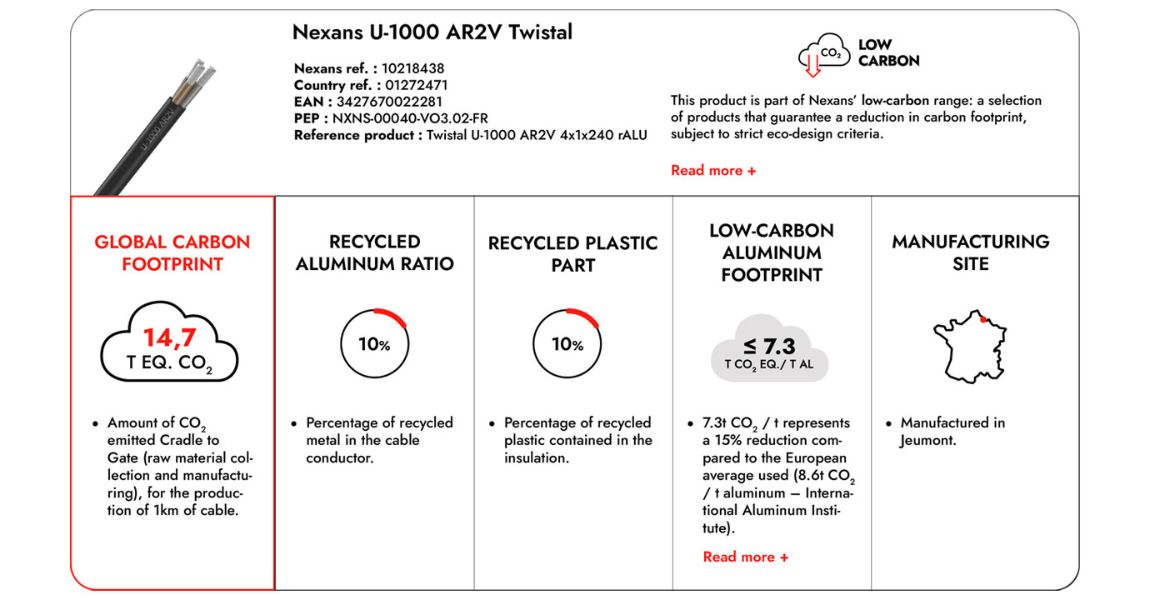
4 clear indicators
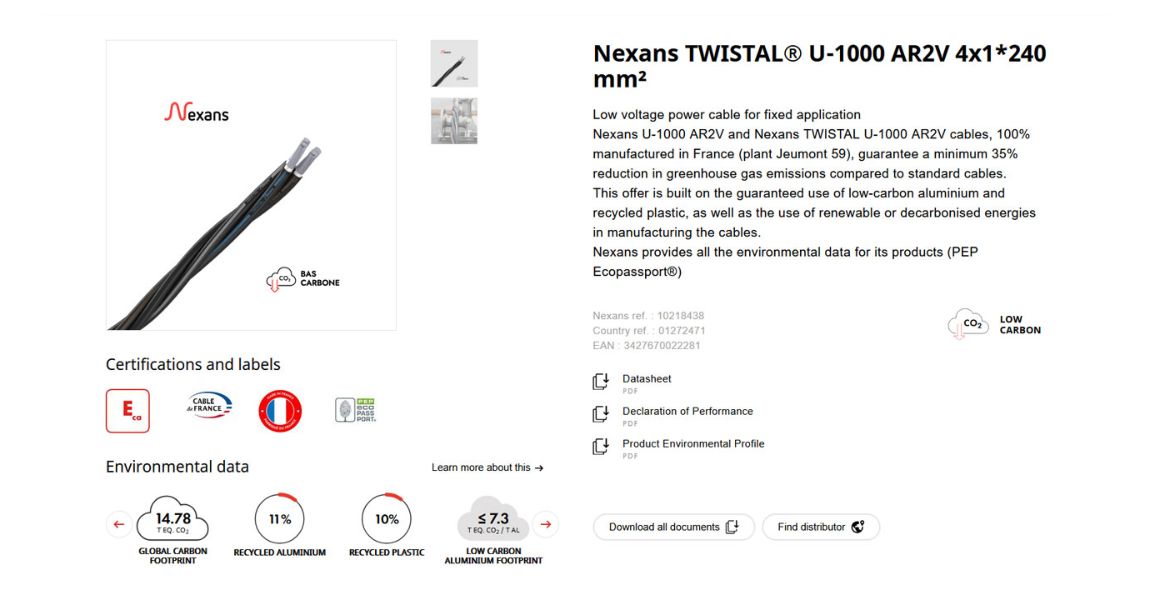
To facilitate access to and understanding of its cables' environmental data, Nexans displays the environmental information from the LCAs of its PEP-certified products in a simple format made of reliable data and a rich set of indicators:
- Simplified data display, easily accessible on products web pages with a third-party certified LCA;
- Reliable and structured data, derived from the Life Cycle Assessment of the product concerned;
- A rich set of indicators, allowing to assess products environmental performance at a glance.
Improving the environmental footprint of cables
In order to improve the environmental footprint of its cables, Nexans leverages on the most significant cradle-to-gate criteria that serve as the basis for the indicators displayed on environmental labels.
1. Integration of recycled materials
- Metal conductors account for between 70% and 90% of a cable's total cradle-to-gate carbon footprint. Integrating recycled copper or aluminum is therefore the most impactful lever for improvement.
- Integration of recycled materials and high purity requirements to guarantee the performance and compliance of low-carbon products.
2. Supply of low-carbon footprint aluminum
- Aluminum from production processes powered by a carbon-free energy mix (nuclear, solar, hydro, etc.).
- 100% of aluminum cables in France are made from decarbonized aluminium.
For example, activating these two levers has resulted in a 40% reduction in CO₂ emissions for aluminum products in the Nexans TWISTAL range in France* (CO₂ savings achieved on the Nexans U1000 AR2V TWISTAL 4x1x240 rALU product range (EcoPassport reference: NXNS-00040-V03.02-FR), compared to the same product reference without the improvements: recycled raw materials and aluminum produced using carbon-free energy).
Nexans low-carbon cable range: guaranteed improved carbon performance
As a pioneer in sustainable electrification, Nexans supports its customers in making informed decisions and sustainable choices.
To identify Nexans' most environmentally friendly products, the Group affixes the “Low Carbon” symbol to products whose carbon footprint has been optimized by acting on one of the following criteria:
- A minimum of 10% recycled copper or aluminum
- 100% sourcing of “low-carbon” aluminum*
This clear and harmonized identification helps support sustainable innovation, guide industrial choices, and strengthen customers' ability to favor solutions with reduced environmental impact.
*Aluminum with an environmental footprint equal to or less than 7.3 tCO2, representing a 15% reduction compared to the European average (8.6 tCO2/t of aluminum) - [Source: European Aluminum Association – February 2018 – Environmental Profile Report].
我们的网站
选择你的国家查找我们的产品和解决方案
-
Africa
- Africa
- Ghana
- Ivory Coast
- Morocco
- North West Africa
- Americas
- Asia
- Europe
- Oceania